
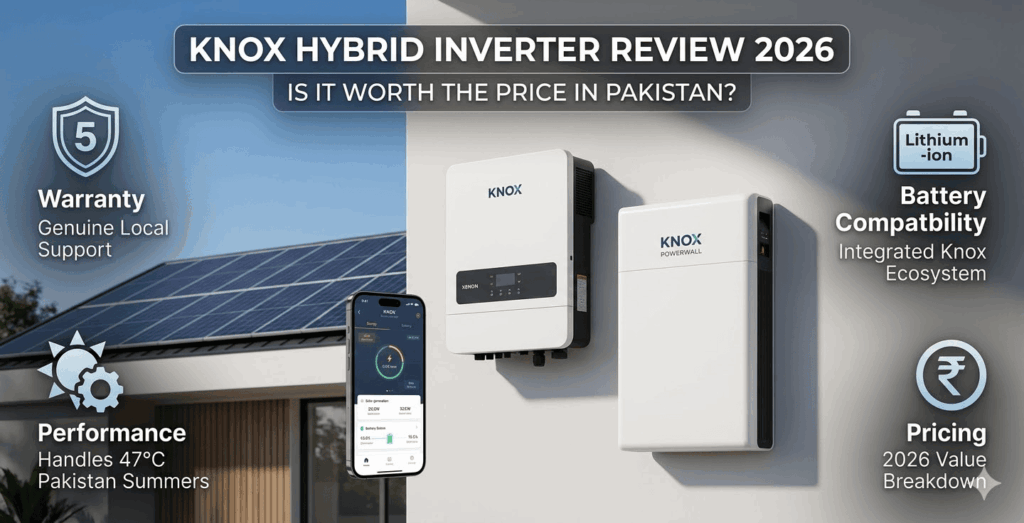
Knox Hybrid Inverter Review
If you have spent any time researching solar energy in Pakistan recently, you have almost certainly come across the Knox name. It is on social media groups, in solar market discussions in Lahore’s Hall Road, and increasingly being recommended by installers across the country. But recommendations alone do not tell you whether a product is genuinely worth your money, especially when you are about to spend anywhere from two hundred thousand to over half a million rupees on a complete solar setup.
This review exists to give you a straight answer. We have gone through the Knox hybrid inverter range in detail, covering the technical specifications that actually matter in Pakistani conditions, the pricing reality in 2026, the warranty situation, battery compatibility, and the kind of buyer who gets the most value out of this product. If you are sitting on the fence about whether Knox is the right choice for your home or business, this is the review that should help you decide.
Why a Hybrid Inverter Makes Sense for Pakistan in 2026
The energy situation in Pakistan has pushed most serious solar buyers toward hybrid inverters, and for very good reasons. A standard on grid inverter, which was popular a few years ago, has one critical flaw in the Pakistani context. It shuts down completely the moment WAPDA trips. So even if your rooftop is covered in solar panels and the sun is blazing at full intensity, an on grid only system goes dark during load shedding. For a country where outages routinely run six to twelve hours in many cities, that is simply not a workable solution anymore.
An off grid inverter solves the load shedding problem but creates a different one. Without grid connectivity, you cannot take advantage of net metering, you cannot charge your batteries from the grid during off peak hours at lower rates, and your entire energy supply depends on how much sun you got that day. During monsoon or winter months in northern Pakistan, that is a real vulnerability.
The hybrid inverter is the product that Pakistani buyers actually need. It manages all three sources of energy simultaneously. Solar panels feed in during daylight. The battery bank stores whatever is not immediately consumed. The grid tops up the batteries when prices are low or solar generation is insufficient. When the grid fails, the system switches to battery and solar automatically, usually in under 20 milliseconds, which is fast enough that your appliances and electronics never notice. This is why hybrid inverters have become the dominant choice in the Pakistani residential and commercial solar market in 2026.
Knox as a Brand: Where Does It Stand in the Pakistani Market
Knox occupies an interesting position in Pakistan’s solar market. It is not the cheapest option you will find, and it does not try to be. The brand is positioned in the mid to upper segment, competing directly with names like Inverex, Growatt, and SolarMax rather than the grey market imports that flood the lower end of the market.
What distinguishes Knox from the cheaper alternatives is not just the hardware but the distribution model. Knox products in Pakistan are sold through authorized distributors and official dealers, which means when you buy a Knox inverter you are getting genuine warranty coverage backed by a supply chain that actually exists locally. In a market where many buyers have been burned by cheap inverters with no local after sales support, this matters more than most people realize at the point of purchase. It usually becomes apparent two or three years into ownership when something needs attention.
The brand has been particularly focused on building out its hybrid inverter and lithium battery ecosystem together, which reflects a smart understanding of where the Pakistani solar market is heading. Buyers who want a complete, integrated system rather than mixing and matching components from different brands have a clear pathway with Knox.
The Knox Hybrid Inverter Lineup: Which Model Is Right for You
Knox currently offers several hybrid inverter models in Pakistan, and the right choice depends almost entirely on your energy consumption profile. The two series that get the most attention are the Xenon and the Xynex.
Knox Xenon Series
The Xenon series is built around the residential market. The Knox Xenon 12066 IP66 6.6kW is the most popular model in this line and is designed to handle the energy needs of a typical Pakistani middle class home. The 6.6kW rating means it can simultaneously power ceiling fans, a refrigerator, LED lighting, a television, and moderate air conditioning loads without struggling. The IP66 weatherproofing certification is worth highlighting separately because it means the unit is fully protected against dust ingress and against high pressure water jets, making it one of the few inverters in this price range that can genuinely be installed outdoors without needing an additional enclosure.
For buyers with heavier requirements, the Knox Xenon 18000 IP65 at 12kW steps up the capacity significantly. This model is appropriate for larger homes running multiple air conditioners simultaneously, or for small commercial setups like a retail shop or a small factory floor. You can explore these options at Pak Solar Shop’s hybrid inverter range where current pricing and availability are listed.
Knox Xynex Series
The Xynex series introduces three MPPT inputs, which is a meaningful upgrade for installations where the rooftop layout is not ideal. The Knox Xynex 10KW with three MPPT channels and 18000W PV input capacity allows you to connect three separate strings of solar panels independently, each optimized for its own orientation or shading conditions. In practice, this means a rooftop where one section faces east, another faces west, and a third faces south can all be connected without the least productive string dragging down the output of the better performing ones. For urban Pakistani homes with complex rooftop arrangements, this is a genuinely useful feature rather than a marketing checkbox.
The Xynex 8KW sits between the 6kW Xenon and the 10KW Xynex, offering a middle ground for homes whose load profile falls in that range. For a household running two 1.5 ton air conditioners along with standard appliances, the 8KW is often the right size rather than oversizing to 10KW unnecessarily.
Technical Specifications That Actually Matter in Pakistani Conditions
MPPT Performance Under High Temperature
Pakistan’s summers are brutal, and solar panels lose efficiency as temperatures rise. The MPPT controllers in Knox hybrid inverters are designed with wide voltage input ranges that accommodate the fluctuations in panel output voltage as temperatures swing from a cool morning to a 45 degree afternoon. An MPPT controller that handles this range well extracts measurably more energy from the same panel array over the course of a full day compared to one with a narrower operating window.
Battery Compatibility and Communication
Knox hybrid inverters are built to work with both lithium iron phosphate and standard lead acid batteries, but their performance is noticeably better in a lithium setup. When paired with a Knox lithium battery like the Knox Powerwall 7.1 IP65 with LCD display, the inverter and battery communicate through a BMS protocol that optimizes every charge cycle. This means the battery charges to the right voltage, discharges to the right depth, and the overall system life is extended significantly. Lead acid batteries remain compatible for buyers with existing battery banks, but anyone starting fresh in 2026 should strongly consider lithium from the outset.
Grid Tie and Net Metering Readiness
All Knox hybrid models are net metering ready, meaning they can be configured to export surplus solar generation back to the national grid in exchange for billing credits. Models in particular meet the minimum inverter capacity requirement that most Pakistani DISCOs apply when processing net metering applications. For homeowners and businesses who want to offset their electricity bills by selling back excess power, this is an important technical checkbox to confirm before purchasing.
Real World Performance: How Knox Hybrid Inverters Handle Pakistani Conditions
The specification sheet is one thing. What actually happens during a peak summer afternoon in Multan when the temperature is 47 degrees, the grid has just failed, and two air conditioners are running simultaneously is a different question entirely.
Knox hybrid inverters have developed a reputation for handling these load switching scenarios cleanly. The changeover from grid to battery and solar when WAPDA trips happens fast enough that sensitive electronics do not reset or lose data. Air conditioners, which have large compressor motors that create surge currents when starting, are handled without the inverter tripping on overcurrent, provided the inverter is correctly sized for the load.
The built in thermal management, which uses active cooling fans combined with ventilated casings, keeps the operating temperature within safe limits even during extended peak load periods. Budget inverters without adequate thermal management tend to reduce output or shut down during the hottest hours of the day, which is precisely when solar generation and demand are both at their peak. Knox models do not show this pattern under normal operating conditions.
The Wi Fi monitoring feature available on current models is a genuinely useful addition. The companion smartphone app shows live generation, consumption, battery state of charge, and grid import or export figures in real time. Pakistani users who have adopted this feature report that it changes how they manage energy at home. Running the dishwasher and washing machine during peak solar generation hours rather than in the evening, for example, shifts those loads entirely to free solar power and away from the battery bank, extending the battery reserve for the load shedding hours.
Knox Hybrid Inverter Price in Pakistan: Breaking Down the Value
Price is where most Pakistani buyers spend the most time deliberating, and the conversation usually starts with someone finding a cheaper alternative on OLX or a market stall and asking why they should spend more on Knox.
The honest comparison needs to include the full picture. A cheaper inverter with no local warranty support that fails in year two costs you the replacement inverter plus the labour to reinstall it plus the electricity bills you paid during the weeks without solar power. When you add all of that up, the price premium on a Knox unit with a five year warranty and genuine after sales support frequently works out to be the more economical choice over a five year period.
The Knox Xenon 6kW is available at competitive pricing through authorized dealers including Pak Solar Shop, where current discounted prices are listed directly on the product pages. The 10KW Xynex is priced in a range that competes closely with equivalent capacity Growatt and Inverex models, and in some configurations it comes out more affordable when current market pricing is compared directly.
For buyers planning a complete system, the economics improve further when you factor in lithium battery pairing. The
Knox Rackwall 10.5 lithium battery at 200AH capacity paired with a Knox hybrid inverter creates a unified system where both components are tested to work together, which removes the compatibility guesswork that comes with mixing brands. A 200AH lithium bank at 51.2V stores over 10 kilowatt hours of usable energy, enough to run a standard Pakistani household through a ten hour load shedding window without significantly depleting the reserve.
Who Should Buy a Knox Hybrid Inverter and Who Should Not
Knox hybrid inverters are the right choice for homeowners and small business owners in urban and semi urban Pakistan who have grid access, face regular load shedding, and want a system that is built to last a decade with minimal intervention. They are particularly well suited to buyers who are planning a complete system with lithium batteries, because the integrated Knox ecosystem produces better results than a mixed brand setup.
They are also a sensible choice for anyone who values warranty security. In Pakistan’s solar market, the warranty on paper is only as good as the dealer’s ability and willingness to honour it. Buying through an official Knox distributor removes that uncertainty.
Knox hybrid inverters are probably not the right choice for buyers whose primary concern is the absolute lowest upfront cost and who are comfortable with the risk that comes with cheaper products. For genuinely remote off grid agricultural setups requiring very large three phase power capacity, Knox’s current residential focused range may also not cover the requirement, and a specialized industrial solar installer would be a better starting point for those projects.
Frequently Asked Questions About Knox Hybrid Inverters in Pakistan
How long is the Knox hybrid inverter warranty in Pakistan?
Knox hybrid inverters come with a five year warranty when purchased through authorized distributors. This covers manufacturing defects and component failures. The warranty is enforced through the official distribution channel, so purchasing from a verified dealer is essential for the coverage to apply.
Can I install a Knox hybrid inverter outdoors in Pakistan?
Yes. The IP65 and IP66 rated models in the Knox range are designed for outdoor installation. The IP66 rating on the Xenon 12066 in particular provides full protection against dust and high pressure water, making it suitable for Pakistani rooftop and external wall mounting without needing an additional protective enclosure.
Does Knox hybrid inverter support net metering in Pakistan?
Yes. All current Knox hybrid models are net metering compatible and can be configured to export surplus solar generation to the grid. Buyers should confirm with their local DISCO that the inverter model they are purchasing meets the specific requirements for net metering approval in their region, as these requirements can vary slightly between distribution companies.
Which battery is best to pair with a Knox hybrid inverter?
Knox lithium batteries are the recommended pairing because they communicate directly with Knox inverters through BMS integration, optimizing charge and discharge cycles automatically. For buyers who prefer lead acid, Knox inverters support AGM and tubular lead acid batteries as well, though the performance and lifespan advantages of lithium make it the better long term investment.
Final Verdict: Should You Buy a Knox Hybrid Inverter in 2026
Knox has built a hybrid inverter range that is genuinely well suited to Pakistani conditions. The IP rated enclosures handle the environmental challenges. The MPPT controllers extract real world performance from panels across varying temperatures and orientations. The lithium battery compatibility future proofs the system. And the distribution model means the warranty is not just a number on paper.
It is not the cheapest product in the market. If your budget is the single deciding factor and you are willing to accept the associated risks, there are cheaper alternatives available. But if you are approaching this as a ten year investment in your home’s energy independence and you want to minimize the probability of expensive problems along the way, Knox sits in a strong position in its category.
For the most up to date pricing, model availability, and to purchase directly from an authorized Knox distributor in Pakistan, visit Pak Solar Shop. The full Knox hybrid inverter and lithium battery range is listed with current pricing and you can reach their team directly for any pre purchase questions about sizing and configuration for your specific requirements.