
BMS For Lithium Solar Batteries
If you have recently started researching solar energy for your home or business in Pakistan, you have almost certainly come across the term BMS. It appears on product pages, in installation guides, and in conversations at every solar market from Hall Road in Lahore to Saddar in Karachi. But most buyers glance past it without fully understanding what it does or why it matters so much. That is a mistake, because the BMS is arguably the single most important safety and performance component in any modern lithium solar battery system.
This guide explains what a Battery Management System actually is, how it works inside a lithium ion battery, and why it is particularly critical for Pakistani conditions where extreme heat, voltage fluctuations, and frequent load shedding put batteries under stress that most other countries simply do not experience.
BMS Full Form and Basic Definition
BMS stands for Battery Management System. At its core, it is an electronic circuit board embedded inside a lithium battery pack that monitors and controls how the battery charges and discharges. Think of it as the brain of the battery. It does not store energy itself, but it governs every aspect of how energy flows in and out of the cells.
Without a BMS, a lithium ion battery is essentially an unguarded chemical reaction. Charge it too fast, discharge it too deeply, expose it to extreme temperatures, or let individual cells drift out of balance, and the battery does not just underperform. In serious cases, it can fail catastrophically through a process called thermal runaway, where one overheated cell triggers a chain reaction through the entire pack. A properly designed BMS prevents all of this from happening.
Every reputable lithium battery available in Pakistan today, whether it is a Knox Powerwall, an Itel ESS unit, a Sunwoda Atrix, or an Inverex Power Wall, includes a built-in BMS as a standard feature. When you compare lithium battery prices in Pakistan, you are not just comparing chemistry and capacity. You are also comparing the quality and sophistication of the BMS inside.
How a Battery Management System Works
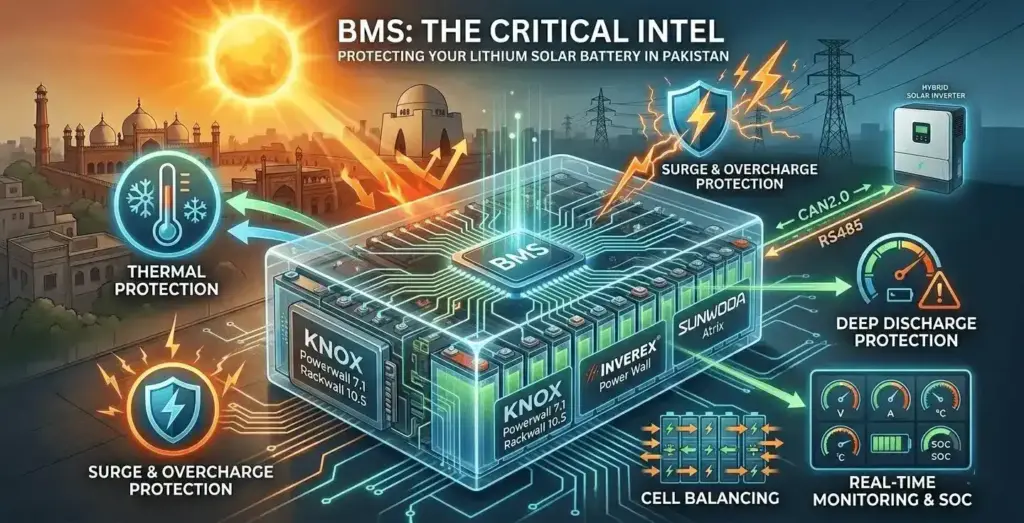
Understanding how a BMS works helps you appreciate why it is indispensable rather than just another technical specification. The system operates across three primary functions: monitoring, protection, and cell balancing.
Monitoring and State of Charge Tracking
The BMS continuously measures the voltage, current, and temperature of every cell in the battery pack. From these measurements, it calculates the state of charge (SOC), which is the battery’s equivalent of a fuel gauge. It tells your inverter and monitoring app how much energy is stored at any given moment. Accurate SOC readings matter practically. When your hybrid inverter decides whether to draw from the battery or from the grid during load shedding, it relies on the SOC data from the BMS to make that decision correctly. A battery with a poorly calibrated BMS gives inaccurate readings that can lead to the battery being discharged further than intended, reducing its lifespan over time.
Protection Against Overcharge and Deep Discharge
Overcharge protection is one of the most critical functions of any BMS, especially in Pakistan. Our grid voltage fluctuates considerably, and during certain hours when supply is restored after a long outage, charging currents can spike. A BMS monitors the incoming charge voltage and cuts off charging the moment cells approach their maximum safe voltage threshold. Without this protection, overcharging a lithium iron phosphate battery does not just reduce its capacity. It generates heat, accelerates cell degradation, and in less stable lithium chemistries can cause fire.
Deep discharge protection works on the other end of the spectrum. Every lithium ion battery has a minimum safe voltage below which the cells begin to suffer permanent chemical damage. During extended load shedding periods in cities like Multan, Quetta, and Peshawar, where outages can stretch beyond ten hours, a battery without deep discharge protection will keep supplying power until the cells are irreversibly damaged. The BMS shuts the battery down before that threshold is reached, preserving the cells for the next charging cycle.
Cell Balancing
A lithium battery pack is made up of many individual cells connected in series and parallel. Over time and through repeated charge and discharge cycles, individual cells naturally drift slightly apart in their voltage and capacity. Some cells become slightly stronger, others slightly weaker. If left unmanaged, the weakest cell in a series string becomes the limiting factor for the entire pack. The BMS actively balances the cells by redistributing charge from stronger cells to weaker ones, ensuring the entire pack ages evenly and that you get the rated capacity for as many cycles as possible.
Why BMS Quality Matters More in Pakistan Than Almost Anywhere Else
Pakistan’s operating environment is genuinely tough on batteries. Summer temperatures in cities across Punjab and Sindh regularly exceed 45 degrees Celsius, and rooftops and utility rooms where batteries are often installed can see ambient temperatures even higher. Heat is the single biggest enemy of lithium cell longevity, and a BMS with robust thermal management is not a luxury in these conditions. It is a necessity.
The constant cycling between grid power and battery power, driven by Pakistan’s load shedding schedule, also means that Pakistani solar batteries go through more charge and discharge cycles per year than equivalent systems in more stable electricity markets. A battery in a European home might complete one full cycle per day. A Pakistani battery in a city with six to eight hours of daily load shedding might complete one and a half to two cycles. Over five years, that compounds into a significantly higher total cycle count, which makes cell balancing and depth of discharge control by the BMS even more consequential for how long the battery actually lasts.
Voltage fluctuations from WAPDA supply are another Pakistan specific challenge. When grid power is restored after an outage, the incoming voltage is not always clean or stable. A high quality BMS communicates with the inverter to manage how quickly the battery accepts charge under these conditions, preventing the kind of sudden high current inrush that degrades cells prematurely.
How Leading Lithium Battery Brands in Pakistan Implement BMS
The BMS technology in a lithium battery is what separates premium products from budget alternatives, and it is worth understanding how some of the leading brands available in Pakistan approach it. Knox lithium batteries, including the Knox Powerwall 6.1 and the Knox Rackwall 10.5, use integrated BMS with RS485 and CAN communication protocols. This means the battery actively communicates with the Knox hybrid inverter rather than operating as a passive storage unit. The inverter and battery work together as a system, with the BMS relaying real time cell data that the inverter uses to optimize charging strategy based on current temperature, state of charge, and grid conditions.
Itel, whose lithium batteries carry the LiFePO4 (lithium iron phosphate) chemistry, includes a smart BMS with overcharge, over discharge, short circuit, and temperature protection as standard across their range. Their IPL-51100 and ESS series support up to 6000 charge cycles at 80% depth of discharge, a figure that is only achievable because the BMS consistently prevents the kind of stress events that prematurely age cells.
Sunwoda, a global lithium battery manufacturer whose Atrix series is available in Pakistan through local distributors, builds BMS technology with modular architecture. Their batteries can be expanded from 5kWh upward and the BMS manages the entire expanded pack as a single unit, balancing cells across modules. You can learn more about the Sunwoda Atrix product line at Sunwoda Energy’s official site.
Inverex, one of Pakistan’s most established solar brands, includes intelligent BMS with IP65 rated protection in their Power Wall lithium ion battery range. The BMS in Inverex batteries supports parallel expansion of up to 32 units and communicates via CAN2.0 and RS485 protocols, making them compatible with a wide range of hybrid inverter systems. More details are available at Inverex’s official website.
What to Look for in a BMS When Buying a Lithium Battery in Pakistan
Not all BMS implementations are equal, and when you are evaluating lithium battery price in Pakistan alongside quality, the BMS specification is one of the first things to check. The communication protocol matters significantly. A battery with RS485 or CAN communication can be fully integrated with your inverter for intelligent charging decisions. A battery with no communication protocol functions as a passive unit and cannot take advantage of the smart energy management features built into modern hybrid inverters.
The operating temperature range in the BMS specification tells you how the battery will behave in Pakistani summer heat. A BMS rated for continuous operation up to 55 degrees Celsius on the charge side gives you a meaningful safety margin for rooftop installations where ambient temperatures can push that boundary. Anything rated only to 45 degrees needs careful placement in a shaded, ventilated location.
Cycle life rating is the other figure that reveals BMS quality indirectly. A battery rated for 4000 to 6000 cycles at 80% depth of discharge is only capable of achieving that rating if the BMS consistently enforces the depth of discharge limit and maintains cell balance over those cycles. If a manufacturer quotes a high cycle number but the BMS is underpowered for the task, real world life will be considerably shorter.
Choosing the Right Lithium Solar Battery With a Strong BMS for Your System
For most Pakistani homes running a hybrid solar setup, the right starting point is a 48V 100AH lithium iron phosphate battery with integrated smart BMS. The Knox Powerwall 7.1 with IP65 rating and LCD display is one of the stronger options in this category for residential use, offering real time state of charge visibility through its touchscreen interface and BMS communication with Knox hybrid inverters for fully integrated system management.
For larger systems, the Knox Rackwall 10.5 at 200AH capacity provides over 10 kilowatt hours of usable storage with a BMS designed to manage the higher current flows that come with larger capacity. This is the appropriate scale for homes running multiple air conditioners through extended outage periods or for small commercial setups where energy reliability is critical.
Whatever brand or capacity you choose, the principle is the same. A lithium ion battery is only as reliable as the BMS protecting it. In Pakistan’s operating environment, with the heat, the cycling demands, and the grid quality challenges that come standard with our electricity infrastructure, a well engineered BMS is not a bonus feature. It is the foundation that everything else depends on.
Frequently Asked Questions About BMS and Lithium Batteries in Pakistan
What is BMS full form in a solar battery?
BMS stands for Battery Management System. It is the electronic control unit inside a lithium battery that monitors cell voltage and temperature, manages charging and discharging, prevents overcharge and deep discharge, and keeps cells balanced across the pack.
Can a lithium battery work without a BMS?
Technically a lithium battery can deliver power without a BMS, but it should never be used that way. Without BMS protection, a lithium ion battery is exposed to overcharge, deep discharge, thermal runaway, and cell imbalance. All of these shorten battery life significantly and in worst case scenarios create safety risks. Every quality lithium battery sold in Pakistan includes a built-in BMS for this reason.
Does the BMS affect how fast a lithium battery charges?
Yes, the BMS controls the maximum charge current accepted by the battery. It communicates with the inverter to regulate charging speed based on the current state of charge and cell temperature. In hot weather, a well designed BMS will slightly reduce charging speed to protect the cells from heat stress, which is the correct behavior even though it may extend charge time during summer afternoons.
How do I know if my lithium battery BMS has failed?
Common signs of BMS failure include the battery refusing to charge or discharge, sudden drops in reported capacity, the battery cutting off under load even when it shows a reasonable state of charge, or the inverter displaying communication errors with the battery. If any of these occur, contact your dealer for diagnosis. Most reputable brands like Knox and Inverex cover BMS failures under their standard warranty.
Is the Knox Powerwall BMS suitable for Pakistani summers?
Yes. Knox Powerwall batteries are designed with operating temperature ranges appropriate for Pakistani conditions. The BMS manages thermal protection and adjusts charge and discharge behavior when temperatures approach the upper operating limit, protecting the cells during the hottest months of the year in cities like Lahore, Multan, and Karachi.