
If you have been living in Pakistan for the last few years, you already know the pain. The load shedding hits in the middle of summer, the fan stops, the kids wake up sweating, and your UPS battery dies faster than it should. You replace it, spend good money, and six months later you are back to the same situation. That cycle is exhausting and expensive.
That is exactly why so many Pakistani homeowners in 2026 are switching to a lithium battery for their solar and backup systems. And if you have not made the move yet, this guide will walk you through everything you need to know in plain, simple language.
What Is a Lithium Battery and Why Is Everyone Talking About It?
A lithium battery is an energy storage device that uses lithium ions to store and release electricity. Unlike the traditional lead acid batteries most of us grew up with, a lithium battery is lighter, more efficient, lasts far longer, and handles Pakistan’s heat much better.
The specific type of lithium battery that has taken over the Pakistani solar market is called LiFePO4, which stands for Lithium Iron Phosphate. You will hear installers and dealers refer to it as LFP. This chemistry was chosen by Pakistan’s government itself under the Battery Manufacturing Policy 2026 to 2031, and for very good reason.
LFP batteries do not overheat or catch fire the way some other lithium chemistries can. They deliver stable voltage throughout the discharge cycle, meaning your appliances run smoothly from the moment the battery starts discharging to the moment it is almost empty. And they can handle deep discharges every single day without falling apart.
The State of Energy in Pakistan in 2026
Pakistan has crossed 5.3 gigawatts of net metered solar capacity as of early 2026. Millions of households now run on rooftop solar panels. Electricity tariffs have climbed to levels that make solar storage not just attractive but practically essential for middle class families.
At the same time, load shedding has not disappeared. Grid instability is still a reality in most cities and many rural areas. So even if you have solar panels, without a good battery to store that energy, you are still vulnerable during cloudy days, at night, and whenever the grid goes down unexpectedly.
This is why the demand for a quality lithium battery has exploded in Pakistan. People are not buying batteries as a luxury anymore. They are buying them as a necessity.
Pakistan’s First Lithium Battery Plant Is Coming
Here is something genuinely exciting that most people in Pakistan do not know about yet. The country is about to get its first domestic lithium ion battery manufacturing plant. Located in Karachi’s Korangi Industrial Area, it is being developed by EV Technologies and is expected to become operational within months.
The National Lithium Ion Battery Manufacturing Policy for 2026 to 2031 is moving through the approval process right now. Once cleared, it will include phased localization targets, tariff reforms on imported battery parts, and performance based incentives for domestic manufacturers.
This matters to you as a consumer because local production will eventually drive down lithium battery prices in Pakistan. Right now, most batteries are imported fully built from China. As local assembly scales up, costs are expected to fall, making the lithium battery even more accessible to ordinary Pakistani families.
The government has specifically approved lithium iron phosphate technology for initial localization because of its safety profile, cost effectiveness, and suitability for both grid storage and solar systems.
Lithium Battery vs Lead Acid Battery: The Real Comparison
Most homes in Pakistan still use lead acid batteries in their UPS systems. These are the heavy, water filled boxes that have been around for decades. They work, but they come with serious drawbacks in Pakistan’s specific environment.
A typical lead acid battery lasts one to three years under Pakistan’s hot climate and with frequent charge discharge cycles. You top up the water, keep it in a ventilated area because it releases gas, and eventually you haul the dead weight out and buy another one.
A lithium battery, by contrast, lasts ten to fifteen years under the same conditions. The depth of discharge is far better too. A lead acid battery should ideally not be discharged below 50 percent of its capacity or it degrades rapidly. A quality LFP lithium battery can be safely discharged to 80 to 90 percent of its capacity every day.
What this means practically is that a 100Ah lithium battery gives you roughly twice the usable energy of a 100Ah lead acid battery. You are paying more upfront, but you are getting far more in return, and you will not be replacing it for over a decade.
There is no gas emission, no water topping, and no corrosion to worry about. It can be installed in a bedroom, a kitchen, or any indoor space without health concerns.
How a Lithium Battery Works With Your Solar System
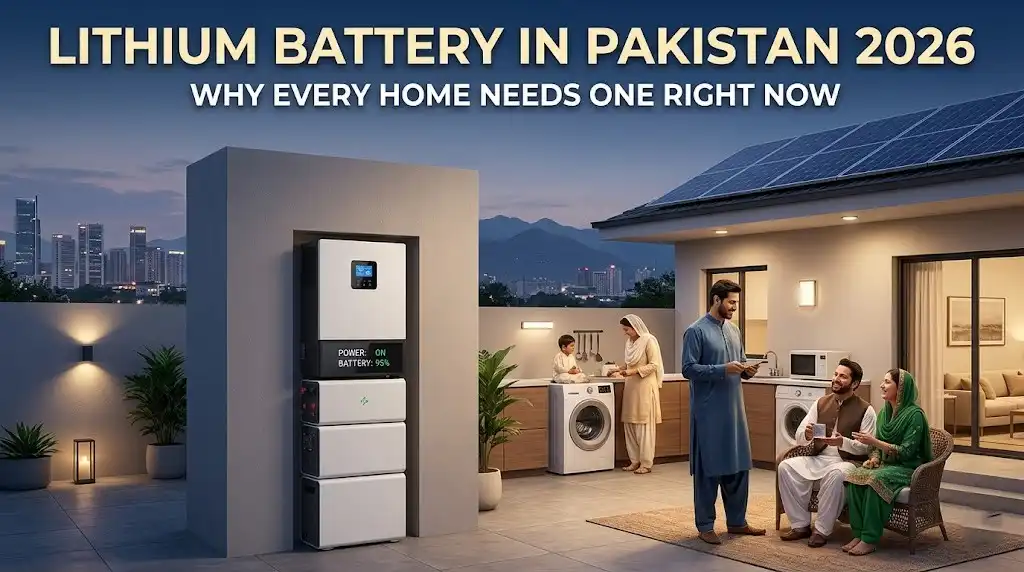
If you already have solar panels installed at home, adding a lithium battery transforms your system from a grid tied setup into a true hybrid or off grid powerhouse. Your panels generate electricity during the day. That electricity charges your lithium battery. At night or during load shedding, you draw from the battery rather than the grid.
Modern lithium batteries come with a Battery Management System built in. This BMS monitors temperature, voltage, current, and state of charge in real time. It protects the battery from overcharging, deep discharge, and short circuits. It also communicates with your inverter so the whole system operates intelligently.
The flat discharge curve of LFP batteries is particularly important for Pakistani households. As the battery discharges, its voltage stays remarkably stable until it is nearly empty. This means your inverter operates efficiently throughout the backup window rather than struggling with dropping voltage at the end of the cycle, which is a common problem with lead acid batteries.
If you are planning a solar upgrade or installing a new system, explore our range of solar panels at PakSolarShop that are compatible with the latest lithium battery storage systems.
What Capacity Do You Need?
Sizing a lithium battery correctly depends on your power consumption and how many hours of backup you need. Here is a simple starting point for Pakistani homes.
A typical household running ceiling fans, a few LED lights, a refrigerator, and a small television consumes roughly 500 to 800 watts per hour during the evening. If you want six hours of backup, you are looking at 3 to 5 kilowatt hours of usable storage.
Since a quality LFP battery can be discharged to 80 to 90 percent, a 5.12 kWh battery (such as the popular 51.2V 100Ah configuration widely available in Pakistan) will comfortably meet that need.
For homes running air conditioning, the math changes significantly. A single one ton inverter AC unit consumes around 700 to 900 watts. Running it alongside other appliances can push your load to 1.5 to 2 kilowatts or more, requiring either a larger battery bank or a modified usage pattern.
It is always better to consult with a qualified installer who can assess your actual consumption from your electricity bills and design a system that is neither undersized nor wastefully oversized.
Lithium Battery Price in Pakistan 2026
Prices have come down meaningfully over the last two years and continue to trend lower. Here is a general picture of where the market sits today.
A 12V 100Ah lithium battery suitable for small UPS and backup applications starts around Rs. 70,000 to Rs. 80,000.
A 51.2V 100Ah LFP battery, which is the most common choice for residential solar storage, typically ranges from Rs. 220,000 to Rs. 270,000 depending on brand and specifications.
Larger rack mounted systems in the 10 to 15 kWh range, popular for commercial use or larger homes with AC loads, can range from Rs. 500,000 to Rs. 650,000.
Well known brands available in Pakistan include Pylontech, Dyness, Crown, PylonTech FIDUS, Fronus, Inverex, and Soluna, among others. Prices reflect cell quality, BMS specification, warranty terms, and availability of local after sales support.
When comparing prices, do not let a low sticker price be your only consideration. A cheap battery with poor BMS protection can fail within a year or two, costing you far more in the long run than a reputable brand with a genuine warranty.
For the latest prices and available stock, check our lithium battery collection at PakSolarShop where we stock verified brands with full warranty support.
Key Things to Check Before Buying
Shopping for a lithium battery in Pakistan requires some homework because the market has grown very fast and not every product is as described.
First, confirm the chemistry. Ask specifically whether the battery uses LiFePO4 or LFP cells. Some sellers list products as lithium ion but use NMC chemistry, which runs hotter and carries more risk in Pakistan’s summer temperatures.
Second, ask about the cycle life rating. A genuine LFP battery from a reputable manufacturer should be rated for at least 3,000 cycles at 80 percent depth of discharge. High quality batteries are rated for 5,000 to 6,000 cycles, translating to twelve to sixteen years of daily use.
Third, check the BMS specifications. The Battery Management System should protect against overcharge, over discharge, over temperature, over current, and short circuit. Ask the seller to show you the technical datasheet.
Fourth, verify the warranty. A quality lithium battery should come with at least a three to five year manufacturer warranty. Make sure the warranty is actually serviceable in Pakistan and that the seller can support a claim without sending the battery back to China.
Fifth, check inverter compatibility. Not every inverter works seamlessly with every lithium battery brand. Your installer should confirm compatibility with your specific inverter model before purchase.
The Electric Vehicle Connection
The surge in lithium battery demand in Pakistan is not just about home solar storage. Electric bikes and e scooters are selling in rapidly growing numbers as petrol prices continue to press household budgets. These vehicles all run on lithium batteries.
Pakistan’s upcoming battery manufacturing plant in Karachi will initially produce batteries specifically for electric bikes, e scooters, and electric vehicles. This reflects a broader national shift toward electrified mobility that will drive further investment in lithium battery technology and infrastructure across the country.
If you are considering an electric bike in addition to a solar storage system, the technology underpinning both is the same: safe, long lasting lithium iron phosphate cells that charge quickly and perform reliably for years.
Is a Lithium Battery Worth It for Your Home?
The short answer for most Pakistani households in 2026 is yes, without much hesitation.
If you already have solar panels and are relying on a lead acid battery that needs replacement, upgrading to a lithium battery is the obvious choice. You will get more usable energy, a lifespan that outlasts two or three cycles of lead acid replacements, zero maintenance, and better performance in heat.
If you are installing solar for the first time, building in a lithium battery from day one saves you from the added cost and disruption of retrofitting storage later.
If you are still on a pure grid connection with a lead acid UPS, the calculation depends on your load shedding hours and budget. For households experiencing six or more hours of load shedding daily, a lithium battery pays for itself in avoided costs and convenience within a few years.
The energy landscape in Pakistan is only going to grow more favorable for battery storage as local manufacturing begins, import tariffs on battery components come down, and the technology continues to mature.
For a complete solar and storage solution tailored to your home’s needs, visit PakSolarShop and speak with our team who can help you design the right system at the right price.