
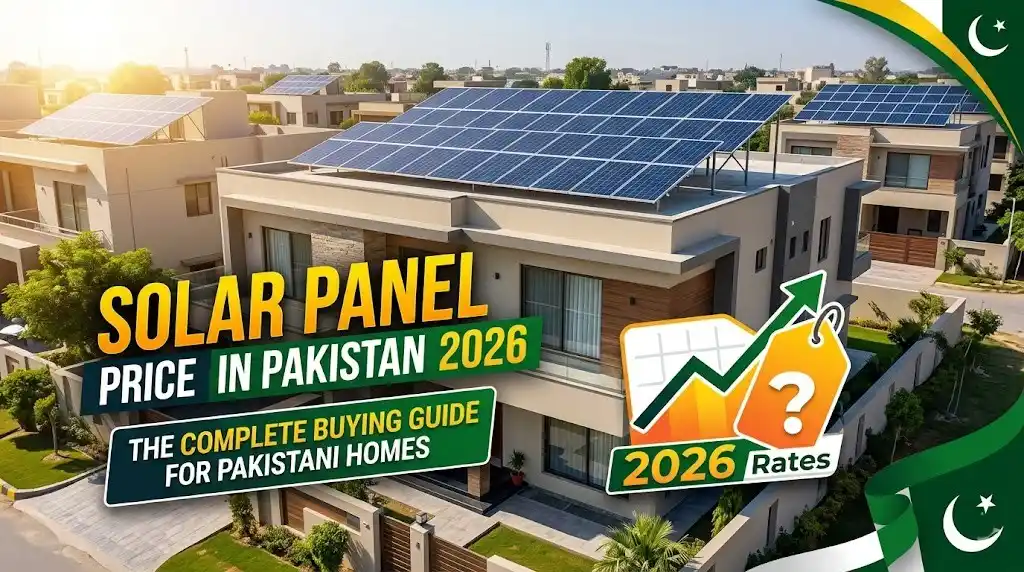
Let us be honest about what is happening to electricity bills in Pakistan right now. Families who used to pay Rs. 8,000 to Rs. 10,000 per month are now getting bills touching Rs. 25,000 or more. Fuel surcharges appear without warning. The tariff revision that came last year hit middle income households the hardest. And load shedding has not disappeared either.
In this situation, more and more Pakistanis are searching for one thing: what is the solar panel price in Pakistan, and can I actually afford to go solar?
The honest answer in 2026 is yes, more comfortably than ever before. Panel prices have dropped dramatically from where they were just a few years ago, the technology has improved, and the government has kept import duties on solar components largely favorable. This guide will walk you through everything you need to know before you spend a rupee.
How Much Has the Solar Panel Price in Pakistan Changed?
If you checked solar prices back in 2022, you might remember being quoted Rs. 120 to Rs. 140 per watt. Those numbers felt unaffordable for most families. The market has changed completely since then.
Today, the solar panel price in Pakistan sits between Rs. 26 and Rs. 43 per watt depending on the brand, technology, and panel wattage you choose. That is roughly a 65 to 70 percent price reduction in three years. The primary reason is a global oversupply of solar panels, particularly from Chinese manufacturers who have scaled production far beyond current global demand.
In early 2026, prices moved up slightly by Rs. 3,000 to Rs. 5,000 per panel compared to the 2025 lows. This happened because global silver and copper costs in manufacturing rose temporarily. However, with the Pakistani rupee holding relatively stable around Rs. 278 per dollar and good existing inventory in the wholesale market, prices have settled and remain at historically affordable levels.
For anyone who was waiting for prices to come down before switching to solar, that moment has already passed. You are now in the most favorable pricing window Pakistan has seen.
Understanding Per Watt Pricing: What It Actually Means
When installers and dealers quote solar panel prices in Pakistan, they almost always use a per watt rate. This is the most useful way to compare panels across different brands and wattages, so understanding it will help you shop smartly.
Per watt simply means: how much are you paying for every watt of generating capacity?
So if a 585 watt panel is priced at Rs. 41 per watt, the panel itself costs Rs. 41 multiplied by 585, which comes to about Rs. 23,985.
Most residential and commercial installations in Pakistan in 2026 use panels between 540 watts and 615 watts. Higher wattage panels cost more per unit, but you need fewer of them. Fewer panels mean less mounting structure, less wiring, and lower labor costs. So a slightly more expensive per panel price can actually work out to a lower total system cost.
Brand by Brand: Current Solar Panel Prices in Pakistan
Here is an updated picture of where major brands stand in Pakistan’s wholesale market as of May 2026. These are A grade, Tier 1, fully documented panel prices. B grade panels are cheaper but carry real risks in quality, output consistency, and warranty fulfillment, and experienced installers will generally advise you to avoid them.
Longi Solar (Hi Mo X10 Series): Rs. 41 per watt. Longi is one of the most trusted brands in Pakistan’s solar market. Their Hi Mo series uses N Type monocrystalline technology with excellent efficiency ratings and a proven track record in Pakistan’s hot climate. Longi panels come with a 12 year product warranty and a 30 year linear performance warranty.
Jinko Solar (N Type Bifacial): Rs. 43 per watt. Jinko is a top performing brand worldwide and has strong presence in Pakistan. The N Type bifacial panels generate electricity from both the front and rear surfaces, meaning reflected light from the roof or ground contributes to output. Premium pricing is justified by genuinely superior performance, especially in summer months.
Canadian Solar (N Type TopCon): Rs. 42 per watt. Canadian Solar’s TopCon panels use a newer cell architecture that reduces electron recombination losses and delivers higher output per square meter. Excellent choice for rooftops with limited space where you want to maximize generation.
JA Solar (N Type): Rs. 40 per watt. JA Solar has gained significant market share in Pakistan over the last two years. Competitive pricing with solid efficiency numbers make it a popular choice for mid range residential installations.
Trina Solar (N Type): Rs. 40 per watt. Trina’s Vertex series panels are engineered especially for high density commercial installations. Strong manufacturing quality and good inverter compatibility.
AstroEnergy (N Type Bifacial): Rs. 41 per watt. Part of the CHINT Group, AstroEnergy is gaining traction in Pakistan. Their bifacial N Type panels work well on rooftops with reflective surfaces and have demonstrated reliable performance in high temperature conditions.
For a verified selection of these panels with genuine warranty documentation, browse our solar panel catalogue at PakSolarShop.
N Type vs P Type: Why This Matters for Pakistani Buyers in 2026
In 2026, the vast majority of new installations across Pakistan use N Type solar panels. If a dealer is still pushing P Type or older Mono PERC technology at the same price point, that is worth questioning.
N Type panels have a lower temperature coefficient, which means they lose less output as temperatures rise. In Pakistani cities where summer temperatures regularly reach 42 to 48 degrees Celsius, this difference is not theoretical. It shows up in your actual monthly generation numbers.
N Type panels also have a better degradation rate. Where older P Type panels might lose 0.45 to 0.55 percent of output per year, N Type panels from reputable manufacturers degrade at around 0.4 percent or less annually. Over a 25 year system life, that gap compounds significantly.
The per watt premium for N Type panels over older P Type technology is typically Rs. 3 to Rs. 5 per watt. This premium pays back within two to three years of operation through higher energy production, making it a straightforward financial decision for most buyers.
What Does a Complete Solar System Actually Cost?
The solar panel price in Pakistan is just one part of the total system cost. A complete solar installation includes panels, an inverter, mounting structure, wiring, circuit protection components, and labor. If you want battery backup, a lithium battery adds a significant but worthwhile additional cost.
Here are realistic 2026 market estimates for complete installed systems:
3 kW Hybrid System (without battery): Rs. 400,000 to Rs. 500,000. Suitable for small homes or apartments with moderate energy needs. Runs fans, lights, a refrigerator, and one or two smaller appliances.
5 kW Hybrid System (without battery): Rs. 620,000 to Rs. 800,000. The most popular system size in Pakistan in 2026. A well designed 5 kW system can support a 1.5 ton inverter AC, a refrigerator, a washing machine, a water pump, fans, and lighting simultaneously. This is the right entry point for most average family homes.
5 kW Hybrid System (with lithium battery): Rs. 850,000 to Rs. 1,100,000. Adding a lithium battery gives you full backup during load shedding and night time use of solar stored energy. Given rising load shedding complaints across many cities, this upgrade is increasingly popular.
10 kW On Grid System: Rs. 950,000 to Rs. 1,200,000. Suited for larger homes, joint family houses, or small businesses. Can handle two to three inverter ACs alongside full household loads. Net metering allows you to export surplus daytime generation to the grid and receive credit on your bill.
10 kW Hybrid System (with battery): Rs. 1,600,000 to Rs. 2,000,000. Maximum energy independence. Suitable for high consumption homes where electricity bills regularly exceed Rs. 50,000 to Rs. 80,000 per month.
How Long Until Your Solar Investment Pays for Itself?
This is the question every practical Pakistani buyer asks, and the math has never looked better than it does right now.
With electricity unit prices exceeding Rs. 60 per unit in most distribution company areas across Pakistan, a well sized solar system generates savings fast. A 5 kW system producing around 600 to 700 units per month at current tariff rates saves a family approximately Rs. 36,000 to Rs. 42,000 monthly on their electricity bill.
At that rate, a Rs. 700,000 system pays for itself in roughly 17 to 20 months of electricity bill savings. After that point, your electricity is essentially free for the remaining 23 to 24 years of the system’s rated life.
Most solar professionals in Pakistan today quote a payback period of three to three and a half years for a typical hybrid system. For homes with higher daytime usage where air conditioning runs on solar power during the day, that payback can come in under two and a half years.
This is why solar is no longer a lifestyle choice in Pakistan. It has become a straightforward financial investment with one of the best returns available to an ordinary household.
What Is Net Metering and Can You Get It?
Net metering is a government approved arrangement that allows solar system owners to export surplus electricity to the national grid and receive credit on their bills. In months where your panels generate more than you consume, those excess units offset future bills.
As of 2026, net metering is active and accessible across all major distribution companies in Pakistan including LESCO, IESCO, MEPCO, PESCO, HESCO, SEPCO, QESCO, and FESCO. The process requires submitting an application and system documentation to your local DISCO after installation.
For most on grid and hybrid solar systems, getting net metering approved takes one to two months after installation. Your installer should guide you through this process and many handle the paperwork on your behalf.
The combination of reducing your own consumption during the day and earning credit for exported units makes the financial case for solar even more compelling, especially for households that are away during daytime hours when generation is at its peak.
Common Mistakes Pakistani Buyers Make When Shopping for Solar
After years of rapid solar growth in Pakistan, certain mistakes have become very common. Knowing them can save you serious money and headaches.
The most frequent mistake is choosing a system based on price alone. A cheaper inverter or an unverified brand of panel might save you Rs. 50,000 upfront but fail within two to three years, wiping out all your savings and leaving you with no warranty support. Always prioritize verified Tier 1 panels and inverters from established brands with local service presence.
The second common mistake is undersizing the system. Many buyers install a 3 kW system thinking it will be enough, then find out during summer that their AC load pushes beyond the system’s capacity. Always calculate your peak load accurately before deciding on system size, and build in a comfortable margin.
The third mistake is skipping a proper site survey. Shading from trees, neighboring buildings, or water tanks can dramatically cut system output. A good installer will assess your roof carefully before recommending a layout.
The fourth mistake is buying without checking warranty documentation. Every A grade panel comes with a physical warranty card and is registered with the manufacturer. Ask your dealer to show you the documentation and verify it.
For expert advice on sizing and selecting the right system for your home, get in touch with our team at PakSolarShop where we offer genuine products with full warranty support.
Factors That Affect the Solar Panel Price in Pakistan
Understanding what moves prices helps you time your purchase and avoid paying more than necessary.
The Pakistani rupee to US dollar exchange rate is the single biggest factor. Since nearly all panels are imported, a weaker rupee directly pushes up prices in the local market. When the rupee was under pressure in 2023, prices spiked significantly. Dollar stability in 2026 has helped keep prices in check.
Seasonal demand also plays a role. Prices tend to rise slightly in April and May as Pakistani households rush to install solar before the peak summer heat. If you can plan your installation during winter months, you may find slightly better pricing and faster installer availability.
Global manufacturing output from China continues to press prices downward over the long term. China’s solar manufacturers have invested so heavily in capacity that supply consistently outpaces global demand, keeping prices falling over multi year periods despite short term fluctuations.
Government import policy matters too. The current framework keeps duties on solar components low, and the government has signaled it intends to maintain this approach. Any change in import duty structure would immediately pass through to retail prices.
Is Right Now a Good Time to Buy?
Yes. Market professionals in Pakistan consistently give this answer when asked in 2026.
Panel prices are near their historical lowest levels. Electricity tariffs are at their highest levels. The payback period has never been shorter. Net metering infrastructure is functioning across all major cities. And installer capacity and quality have improved significantly as the industry has matured.
Waiting for prices to fall further is a reasonable instinct, but it comes with a cost. Every month you delay, you pay full grid electricity rates. The money spent on electricity bills during a waiting period often exceeds any potential savings from a price drop that may or may not materialize.
If your electricity bill is consistently above Rs. 15,000 per month, the financial case to act now is very strong. For bills above Rs. 30,000, it is almost irrefutable.
For a full selection of panels, inverters, lithium batteries, and complete solar system packages at verified market prices, visit PakSolarShop and explore your options with confidence.